What causes facet joint syndrome?
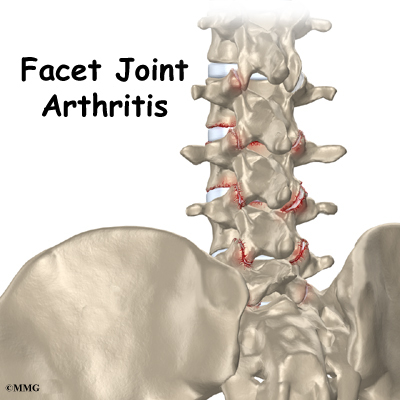
Facet joint syndrome can occur from injury to any components of the joint. The classic causes include wearing down of cartilage, synovial fluid may disappear and this may induce friction in the joint, bony spurs may form which compress or impinge nerves, poor posture, back trauma, infection, arthritis and work related injury (typically heavy lifting)
Who develops facet joint syndrome?
Millions of individuals are affected with this syndrome. The disorder is more commonly seen after the 4th decade of life but can occur much earlier, depending on prior back injury, lifestyle, and type of work
How is facet joint syndrome diagnosed?
Besides a physical exam, some type of radiological study is required to make a diagnosis of facet joint syndrome. The most common radiological study used today is an MRI. Plain x rays may reveal arthritis or formation of bony spurs. Sometimes the physician may inject a numbing medication in the joint and if the pain disappears, the diagnosis of facet joint syndrome is made. If the pain is unrelieved, then it is most unlikely that the pain is caused by a problem with the facet joint.
How is facet joint syndrome treated?
The treatment of facet joint syndrome is always supportive in the beginning. It includes posture correction, changes in lifestyle, participation in a physical therapy program, wearing braces and pain medications.
When these conservative methods fail, other therapies include radiofrequency rhizotomy (use of radiofrequency waves to denervate the pain nerves).
With conservative measures, the majority of individuals with facet joint syndrome improve. About 20% have recurrent back pain for years.
Final note
For the consumer, it is essential not to jump into surgical management as the first step. The results of surgery are poor and recurrent back pain is common.
Showing posts with label facet joint syndrome. Show all posts
Showing posts with label facet joint syndrome. Show all posts
Monday, April 20, 2009



Facet joint syndrome
The orthopedic surgeons and related health professionals love to make medicine sound complex- instead of calling it joint pain now we have facet joint syndrome.
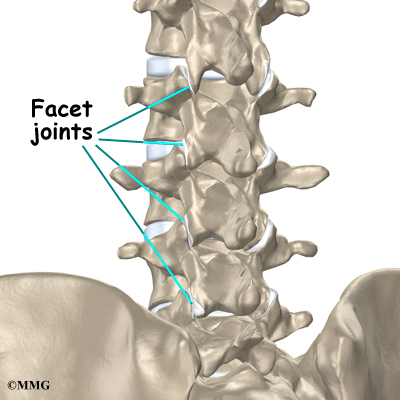
The back is made of many vertebra all aligned in the midline and anatomically arranged to protect the spinal cord. Each vertebra has a facet joint. Facet joints interlink the vertebrae above and below to form a flexible unit that allows the spine to be flexible. This flexibility allows the back to move sideways, forward, and backwards. Facet joints are no different from joints anywhere else in the body
Functions of Facet joint
Like all joints, the surface of facet joint is covered with cartilage whose function is to absorb all trauma and protect the joint. The joint also has a covering, known as synovium that secretes fluid which allows the joint to bend without any friction. The fluid inside the joint is called synovial fluid (it functions just like the oil engine in a car)
What is facet joint syndrome?
Facet joint syndrome occurs when pain arises from any structure within the joint. In the majority of cases, facet joint syndrome occurs in the neck or lower back. The syndrome starts off as an odd ache which worsens with movements or intense activity. Over time, the pain becomes continuous but does respond slightly to pain medications. In the neck area, the pain may radiate to the head, shoulders, upper arms, and back. Sleep is always interrupted because of pain.
When pain develops in the lower back, it is often continuous and often gets worse when one stands for prolonged periods. Often the individual may have difficulty getting up from a chair or bed. Stiffness of lower back is a common complaint first thing in the morning.

The back is made of many vertebra all aligned in the midline and anatomically arranged to protect the spinal cord. Each vertebra has a facet joint. Facet joints interlink the vertebrae above and below to form a flexible unit that allows the spine to be flexible. This flexibility allows the back to move sideways, forward, and backwards. Facet joints are no different from joints anywhere else in the body
Functions of Facet joint
Like all joints, the surface of facet joint is covered with cartilage whose function is to absorb all trauma and protect the joint. The joint also has a covering, known as synovium that secretes fluid which allows the joint to bend without any friction. The fluid inside the joint is called synovial fluid (it functions just like the oil engine in a car)
What is facet joint syndrome?
Facet joint syndrome occurs when pain arises from any structure within the joint. In the majority of cases, facet joint syndrome occurs in the neck or lower back. The syndrome starts off as an odd ache which worsens with movements or intense activity. Over time, the pain becomes continuous but does respond slightly to pain medications. In the neck area, the pain may radiate to the head, shoulders, upper arms, and back. Sleep is always interrupted because of pain.

When pain develops in the lower back, it is often continuous and often gets worse when one stands for prolonged periods. Often the individual may have difficulty getting up from a chair or bed. Stiffness of lower back is a common complaint first thing in the morning.

Subscribe to:
Posts (Atom)